Stop the "Bheja Fry": Mindfulness Exercises for Anxiety
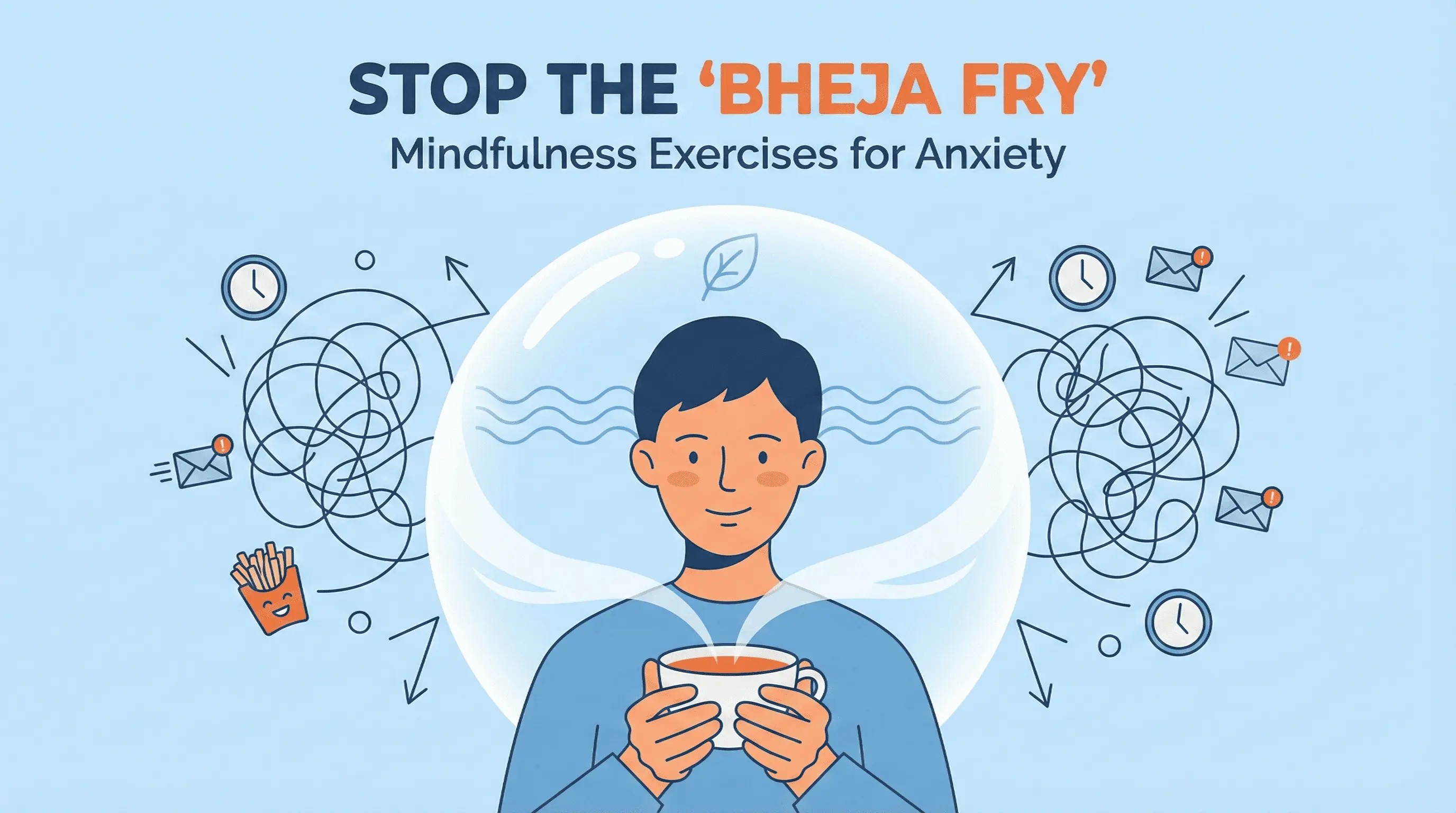
Stop the "Bheja Fry": Mindfulness Exercises for Anxiety That Actually Work
Let’s get the basics straight before we dive in.
Key Takeaways: Quick Fundas
The Truth: Anxiety isn't a disease; it's just your brain trying to "protect" you from imaginary tigers (or deadlines).
The Myth: You don't need to sit cross-legged on a mountain to practice mindfulness. You can do it while stuck in traffic.
The Toolkit: The 5-4-3-2-1 Method is your emergency brake for panic attacks.
The Goal: We aren't trying to stop thoughts. We are just trying to stop drowning in them.
The Hook: The 3 AM Brain Loop
It’s 3:15 AM. You are exhausted. Your body is begging for sleep. But your brain? Oh, your brain is hosting a heavy metal concert.
"Did I send that email with the attachment?"
"Why did I say that stupid thing in 2016?"
"What if I never get a job and have to live in my parents' basement forever?"
Sound familiar? That’s the "Monkey Mind" at full volume. In India, we have a special talent for high-functioning anxiety. We smile, we drink our chai, we say "Sab badhiya hai," but inside, our stomach is in knots.
You’ve probably Googled "how to stop overthinking" a hundred times. You’ve read about meditation. But let's be honest—closing your eyes and trying to "think of nothing" usually just makes you think about everything even harder.
You don't need to become a monk. You just need a mindfulness exercise for anxiety that works in the real world—whether you're in a crowded Metro, a boring meeting, or lying in bed staring at the fan.
The Reality Check: You Are Not Your Thoughts
Here is a concept that might blow your mind: You are not your thoughts; you are the person listening to your thoughts.
Imagine you are standing on a railway platform. Trains are rushing by. These trains are your anxious thoughts ("I'm a failure," "I'm late," "They hate me").
Anxiety is jumping onto every moving train and letting it take you to a bad place.
Mindfulness is just standing on the platform, watching the train pass, and saying, "Oh, there goes the 'Stress Train' again," without getting on it.
It’s not about clearing the mind. It’s about not getting kidnapped by it.
The Guide: 3 Cheat Codes for Instant Calm
Here are three practical exercises you can do anywhere. No yoga mat required.
1. The Emergency Brake: The 5-4-3-2-1 Technique
This is the gold standard mindfulness exercise for anxiety. Use this when you feel a panic attack coming or when your brain is spiraling out of control. It forces your brain to switch from "Thinking Mode" to "Sensing Mode."
Look around you and name:
5 things you can SEE: The crack in the wall, the blue pen, the fan, a bird, your own shoes.
4 things you can FEEL: The fabric of your jeans, the cold table, your feet on the floor, the hair on your neck.
3 things you can HEAR: The traffic outside, the AC humming, a dog barking.
2 things you can SMELL: Coffee, rain, or even just the smell of the room.
1 thing you can TASTE: The lingering taste of toothpaste, or take a sip of water.
Why it works: It tricks your brain. You can't panic about the future when you are hyper-focused on the sensory details of the present.
2. The "Chai Meditation" (The Indian Hack)
You drink tea or coffee every day, right? Usually, while scrolling Instagram. Let’s change that. Turn your morning cup into a ritual.
Step 1: Hold the cup. Feel the warmth transferring to your palms. Don't drink yet. Just feel.
Step 2: Inhale. Smell the ginger, the cardamom, or the coffee beans. Let the aroma hit your brain.
Step 3: Take a sip. Don't swallow immediately. Feel the liquid on your tongue. Is it sweet? Strong? Hot?
Step 4: Swallow and feel it going down your throat.
If your mind wanders to your To-Do list (and it will), just gently say, "Not now, I'm drinking chai," and come back to the warmth. That’s it. That’s mindfulness.
3. Box Breathing (Sama Vritti)
This is used by Navy SEALs and Yogis alike. It physically slows down your heart rate.
Inhale through your nose for 4 seconds.
Hold that breath for 4 seconds.
Exhale through your mouth for 4 seconds.
Hold the empty lungs for 4 seconds.
Repeat 4 times.
Imagine drawing a square box with your breath. It resets your nervous system from "Fight or Flight" to "Rest and Digest."
Comparison: The Anxious Brain vs. The Mindful Brain
Understanding the difference helps you catch yourself when you slip.
Feature | The Anxious Brain (Auto-Pilot) | The Mindful Brain (You in Control) |
Time Travel | Obsessed with the Past (Regret) or Future (Worry). | Anchored in the "Now." |
Reaction | Reacts immediately to triggers (Anger/Panic). | Pauses, observes, then responds. |
Judgment | "I shouldn't be feeling this. I am weak." | "I am feeling anxious. That's okay. It will pass." |
Activity | Multitasking (eating while watching TV while texting). | Single-tasking (just eating, just watching). |
Conclusion: Be Kind to Your "Bheja"
Listen, you are living in a high-pressure world. Your parents expect things, your boss expects things, and Instagram expects you to look perfect while doing it all. It is natural to feel overwhelmed.
Don't treat mindfulness as another "chore" or another thing to fail at. You can't "fail" at this.
If you sit down to breathe for 2 minutes and your mind wanders 50 times, that’s actually a success—because you noticed it wandering 50 times. That noticing is the magic.
So, the next time the anxiety wave hits, don't fight it. Don't drown in it. Just stand on the platform, do the 5-4-3-2-1, and watch the train go by.
Saans lo. Sab theek ho jayega. (Breathe. It’ll be okay.)
Next Step for You: Feeling tense right now? Let's do one minute together. Look away from the screen, find 3 blue objects in your room, and take one deep breath. Go.